Editor's note (20 August 2026): An earlier version of this piece described Fire Point as currently producing around 200 FP-5 Flamingo cruise missiles per month. On 3 August 2026, chief executive Iryna Terekh told The War Zone that the assembly line had missed the seven-a-day target, attributing the gap to slow European Union loan disbursements rather than manufacturing capacity. The paragraph below has been revised to reflect that the 200/month figure was a target, not sustained output.
In the first sixteen days of Operation Epic Fury, United States forces fired 402 Patriot interceptors. Across the 39-day active phase of the early-2026 US-Israeli campaign against Iran, the combined Patriot stockpiles of Saudi Arabia, the United Arab Emirates, Qatar, and Israel were drawn down by roughly 86 per cent. The US Army's THAAD inventory was depleted by close to 40 per cent. Naval SM-3 firings went past eighty. The numbers settle a question that has hovered over Ukrainian air defence for two years. The United States can no longer be the arsenal that backs the Patriot system globally. Production cannot match the demand of two simultaneous theatres, and Washington has chosen CENTCOM reconstitution and INDOPACOM deterrence over European resupply.
Ukraine's response is a mid-war reconstitution of its air-defence stack around European platforms. The Franco-Italian SAMP/T NG is being moved into Ukraine for combat testing against live ballistic threats, with Emmanuel Macron confirming eight systems and Denmark's April 2026 €1.47 billion procurement validating the European pivot at scale. The Rheinmetall-MBDA COMLOG joint venture in Schrobenhausen is being scaled to mass-produce the older Patriot GEM-T interceptor as a volume substitute for the unavailable PAC-3 MSE. A German-Ukrainian programme between Diehl Defence and Fire Point has proposed an indigenous Patriot alternative called Freya, though that programme is now compromised by the Mindich corruption scandal that has frozen the Danish solid-rocket-fuel supply chain it depends on. The 2027 stack Ukraine fields will be a mosaic, not a Patriot replacement.
The Patriot Supply Crisis Is Structural
Lockheed Martin delivered 620 PAC-3 MSE interceptors in 2025. In January 2026 the company signed a seven-year framework agreement with the US Department of War to scale production from approximately 600 to 2,000 units annually by 2030. That scale-up does not help Ukraine in 2026, 2027, or 2028. Every PAC-3 rolling off the Camden, Arkansas line for the next three years is functionally booked by CENTCOM stockpile reconstitution and INDOPACOM deterrence stockpiling.
The Germany-led procurement of 35 PAC-3 interceptors announced in late 2025 illustrates the scale problem. A single M903 launcher can carry up to twelve PAC-3 MSEs, so 35 interceptors represent roughly two full launcher reloads. Russian forces routinely launch saturated salvos of Iskander-M, Kinzhal, and Kalibr against Ukrainian cities; the 35 interceptors cover a small number of engagement cycles before exhaustion. The 4 February 2026 Defense Security Cooperation Agency notification of a $105 million Foreign Military Sale to Ukraine, funded by Berlin's JUMPSTART capital and structured around upgrading legacy M901 launchers to the M903 standard, addresses the launcher fleet's compatibility with the MSE variant. It does not address the missile shortage.
Russia is not waiting for Patriot resupply to fail on its own schedule. On 19 January 2026, an Iskander-M strike near Shevchenko destroyed a Ukrainian Patriot radar and command vehicles. The Iskander's engagement envelope now operates inside the Patriot battery's mobility decision cycle. Dispersed siting against advanced Russian intelligence, surveillance, and reconnaissance cueing is no longer survivable on the frontline timescale. Ukrainian air-defence commanders will be forced to pull surviving Patriot batteries further back to defend Kyiv, Odesa, and Kharkiv, exposing frontline cities to a wider ballistic threat envelope.
The reframing that the May 2026 data forces is that Patriot is not failing technically. The system continues to perform against the targets it was designed for. It is failing economically and logistically. The United States cannot surge PAC-3 MSE production on Ukrainian operational timelines while servicing Israeli, Saudi, Emirati, and Qatari demand, and Lockheed Martin's 2030 capacity target does not bend forward. The political constraint Washington has chosen reflects the industrial constraint Washington faces.
SAMP/T NG and Europe's Anti-Ballistic Bet
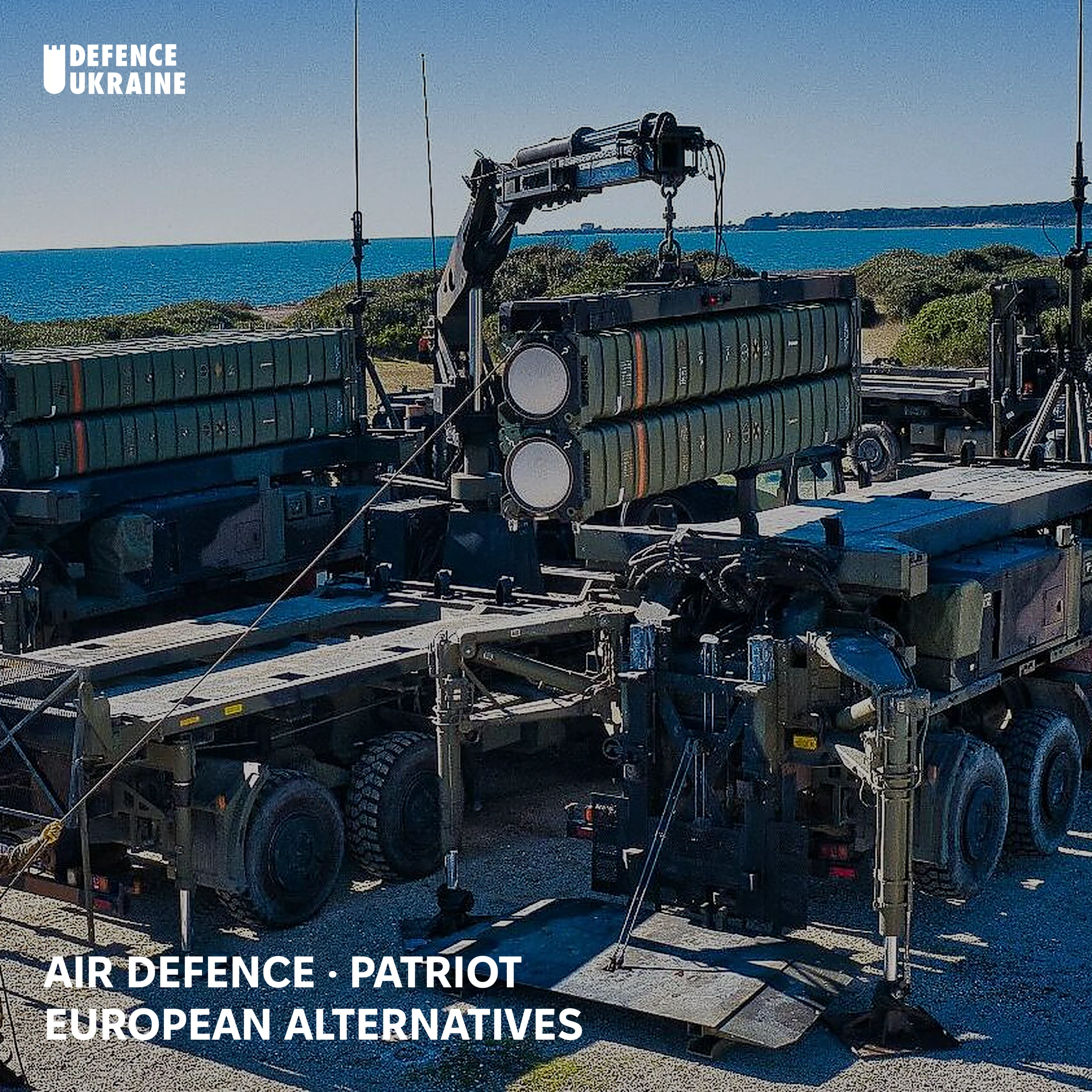
The Franco-Italian Eurosam SAMP/T NG is being asked to anchor Europe's high-altitude air-defence layer for the first time in NATO's history. The system pairs the Aster 30 Block 1NT interceptor (Ka-band seeker, 150-kilometre engagement range, designed against medium-range ballistic and hypersonic threats) with a 360-degree S-band AESA radar (the Thales Ground Fire 300 or the Italian KGM HP). Eurosam, a joint venture between Thales and MBDA, conducted successful qualification firings of the B1NT variant in October 2024, July 2025, and December 2025. The system has not been combat-tested against live, manoeuvring ballistic threats in a contested electronic-warfare environment. That is what the Ukrainian deployment is designed to validate.
President Emmanuel Macron has confirmed that eight SAMP/T NG systems will be moved into Ukraine, with the transfer valued at roughly €3 billion and likely funded through an EU loan mechanism. The dual purpose is genuine. Kyiv gets immediate anti-ballistic coverage, and Paris and Rome get the live-fire validation Eurosam has never conducted. If the SAMP/T NG performs against Russian Iskander-M and Kinzhal threats, the system becomes the default European procurement choice for the high-altitude layer.
Denmark settled the procurement-pattern question on 21 April 2026 with a €1.47 billion contract for four SAMP/T NG batteries, deliberately rejecting the American Patriot. The published reason was the four-to-five-year US delivery timeline against the Italian/French alternative's 2028 starting deliveries. The political signal goes further than the contract value. A traditional NATO purchaser of US air defence has chosen a European platform on availability rather than capability grounds. Defence Ukraine's first-year tracker of SAFE and the Ukraine Support Loan implementation covered the broader European procurement pivot away from US-anchored systems. The SAMP/T NG selection by Denmark is now the cleanest air-defence example of that shift.
MBDA has announced plans to double Aster-family production through 2026 to meet the surge in orders. Production capacity remains constrained by upstream supplier dependencies and the dual-track French-Italian assembly arrangement. Even at doubled output, the SAMP/T NG cannot replace the volume the Patriot system historically supplied to NATO Europe. It can only substitute for the high-altitude tier of the threat envelope that the Patriot can no longer cover.
The COMLOG Volume Bet on GEM-T
Parallel to the SAMP/T NG transfer, NATO planners have executed a volume-over-capability triage by scaling the older Patriot Guidance Enhanced Missile-Tactical (GEM-T) interceptor through the COMLOG joint venture in Schrobenhausen, Germany. COMLOG, founded in 1987 by MBDA Deutschland and Raytheon (now RTX Corporation), is being expanded into the European manufacturing hub for the GEM-T. In April 2026, RTX secured a $3.7 billion direct commercial sales contract to supply GEM-T interceptors to Ukraine, funded largely by the German Ministry of Defence. The contract follows an earlier $5.6 billion NATO Support and Procurement Agency contract executed by Germany, the Netherlands, Romania, and Spain.
The GEM-T is a PAC-2 blast-fragmentation interceptor, not a PAC-3 hit-to-kill. It is highly capable against aircraft, cruise missiles, and legacy tactical ballistic threats. It is not the right effector for a manoeuvring Iskander-M or a Kinzhal. The COMLOG volume bet does not plug the PAC-3 gap. It is a capability downgrade traded for production volume that keeps Ukrainian Patriot launchers loaded with something against the bulk of Russian aerodynamic threats, preventing the batteries from becoming empty assets. The implication is that the burden against the high-end ballistic threat spectrum falls entirely on the unproven SAMP/T NG.
Fire Point, Diehl Defence, and the Mindich Problem
In April 2026, German and Ukrainian officials announced the Freya programme: a joint technology cooperation agreement between Germany's Diehl Defence (the prime manufacturer of the IRIS-T SLM/SLS air-defence systems heavily used in Ukraine) and Fire Point, the Ukrainian defence manufacturer that has grown from a drone startup to a 6,000-person enterprise operating from approximately 70 dispersed sites. Fire Point had been targeting around 200 FP-5 Flamingo cruise missiles per month (3,000-kilometre range), though on 3 August 2026 chief executive Iryna Terekh acknowledged the assembly line had missed that target, blaming slow European Union loan disbursements rather than manufacturing capacity. Fire Point also produces the FP-1 loitering munition and is testing the FP-7 ballistic missile and FP-9 follow-on. Freya is to be an anti-ballistic interceptor based on the FP-7 airframe with Diehl-integrated seekers and guidance.
The programme is structurally similar to the Kongsberg-Ukraine NASAMS co-production agreement on the air-defence side: Western prime architecture and sensors combined with Ukrainian effector manufacturing tailored to the local threat environment. The pattern recurs across the wider industrial-substitution model Ukraine is using when US supply chains close. When the United States chose not to transfer a capability, Europe and Ukraine built the structural alternative.
The Freya programme has been thrown into immediate political risk. On 29 April 2026, the Ukrainian National Anti-Corruption Bureau (NABU) released wiretap recordings implicating sanctioned businessman Tymur Mindich in the financing of Fire Point, with Mindich allegedly offering $1 billion for a 50 per cent stake. The Danish government immediately froze a September 2025 agreement to produce solid rocket fuel for Fire Point in Denmark, cutting off a critical upstream supply node. Adapting an offensive ballistic missile airframe into a precise anti-ballistic interceptor was already a 2030s engineering programme rather than a mid-war solution. The Mindich scandal has now collapsed the financing pathway and the European supplier confidence the programme depended on. Freya is a signal of intent for long-term European-Ukrainian industrial integration rather than a fielded capability Ukraine can rely on against current threats.
The Mosaic Stack Ukraine Actually Fields
The operational stack as of May 2026 has stratified by economics, not by doctrine. High-altitude anti-ballistic coverage rests on an estimated three original US Patriot batteries, heavily targeted and now rationed for Iskander and Kinzhal engagements only. The medium-altitude layer is dominated by Diehl Defence's IRIS-T SLM and SLS, which have achieved a reported near-100 per cent intercept rate across more than 250 engagements; Diehl has invested €1.5 billion in capacity expansion aimed at sixteen batteries annually by 2028. Up to twelve NASAMS batteries from the United States and Norway sit alongside, with the Kongsberg-Ukraine NASAMS effector now in domestic Ukrainian production.
The lower tier has been transformed. Ukraine produced approximately 100,000 interceptor drones in 2025, and these unmanned effectors now account for over 60 per cent of all drone-on-drone neutralisations. The AS3 Surveyor (Sting) class intercepts Shahed loitering munitions at a unit cost under $15,000. Companies including General Cherry logged more than 11,000 confirmed hits in a single month. Defence Ukraine's analysis of Ukraine's interceptor drone development traced the early phase of this layer in August 2025. The May 2026 data shows the interceptor drone moving from auxiliary capability to load-bearing pillar. Firing a €3 million IRIS-T at a $20,000 Shahed is mathematically unsustainable. The pivot to interceptor drones at the bottom is the only factor preserving the medium- and high-altitude SAM stocks for the threats those layers were designed to defeat.
The Rheinmetall Skynex and Gepard short-range systems continue to operate in the mid-low layer. Defence Ukraine's analysis of Rheinmetall's onshoring into Ukraine noted that the four-factory commitment includes a dedicated air-defence-systems plant aimed at producing 35mm AHEAD airburst munitions on-site. That facility, once operational, closes a supply loop that currently runs through German production lines competing against Bundeswehr and other European demand.
Strategic Implications for Ukraine
- The Patriot supply crisis is structural and irreversible on Ukrainian timelines. The 2030 Lockheed Martin scale-up does not bend forward. Operation Epic Fury and the broader Middle East drawdown have committed every new PAC-3 MSE to CENTCOM and INDOPACOM reconstitution through 2029. Ukrainian planners should price the US air-defence pipeline as effectively closed for the remainder of the decade. The political question of US allocation under the second Trump administration overlaps with the industrial reality but does not cause it. Even maximum political will from Washington cannot deliver missiles that have not been produced.
- The SAMP/T NG combat test is the most consequential single procurement decision in European air defence this decade. If the eight Ukrainian systems perform against Russian Iskander-M and Kinzhal targets, the European high-altitude layer transitions from US-anchored to French-Italian-anchored, and Eurosam becomes the default high-altitude procurement choice for NATO Europe. If the system underperforms, NATO's Eastern Flank faces a vulnerability window stretching into the early 2030s while the only alternative high-altitude platform remains a US system that cannot be supplied. European force planners should treat the Ukrainian combat test as a strategic test of the entire European industrial autonomy thesis, not as a tactical capability validation.
- The Fire Point + Diehl Freya programme is a signal of intent rather than a fielded capability. The Mindich scandal exposes a deeper structural problem: European primes are willing to integrate Ukrainian intellectual property and manufacturing on civilian-grade anti-corruption assumptions that Ukrainian wartime governance cannot consistently meet. The same industrial-substitution doctrine Defence Ukraine traced for Ukraine's strike fleet in the Reaper piece applies cleanly on the air-defence side, but only when the political and supplier-confidence conditions are met. The Kongsberg-Ukraine NASAMS model is operationally simpler and politically less exposed. The viable path for the next two years is more Kongsberg-style co-production and less Freya-style indigenous architectural ambition.
- The interceptor drone is the load-bearing pillar of Ukrainian air defence, not a supplementary capability. Sixty per cent of drone-on-drone neutralisations from a 100,000-unit annual production line at sub-$15,000 unit cost has changed the cost-exchange ratio fundamentally. The Eastern Flank Drone Wall NATO is now planning will succeed only if it absorbs this lesson. Premium interceptors cannot scale against massed cheap threats. The European industrial response to massed Shahed-style attacks has to be built around domestic interceptor-drone production, not around the Patriot architecture or its descendants. The CSIS proposal for an "ASAP for Air Defense" mechanism inside SAFE Phase 2, modelled on the EU's 2023 ammunition production initiative, is the procurement-policy version of the same point.
Conclusion
Ukraine's air-defence stack as of May 2026 is being rebuilt mid-war around a structural reality that has not yet penetrated Western policy discourse. The US Patriot system continues to defend strategic Ukrainian targets, but it is not being meaningfully resupplied and it will not be at the cadence the front demands. The European response is partial. The SAMP/T NG transfers to Ukraine for combat testing. The GEM-T scale-up through COMLOG provides volume against aerodynamic threats. The IRIS-T scales through Diehl Defence's €1.5 billion capacity programme. The interceptor drone substitutes at the lower tier. The Fire Point + Diehl Freya programme is paused by domestic corruption concerns the European supply chain has signalled it will not absorb. The 2027 stack will be a mosaic anchored by European platforms and indigenous Ukrainian interceptors. The strategic question for the next eighteen months is whether the SAMP/T NG combat test validates Europe's autonomous high-altitude capability or exposes the gap the Patriot's retreat has created.
Defence Ukraine's analysis of how the May 2026 Baltic drone incursions are accelerating NATO's Drone Wall covers the parallel story at the lower-tier interceptor layer: the European Eastern Flank is now converging on the same mosaic doctrine, on a Q3 2026 procurement timeline forced by the Latvian government fall and the Vilnius Parliament bunker evacuation.
Defence Ukraine's analysis of the 1-2 June 2026 saturation salvo against Kyiv is the operational confirmation of the supply-side thesis above: the high-tier intercept rate fell to 26.8 per cent, with thirty ballistic and hypersonic effectors penetrating the network and zero of eight Russian Zircon hypersonics intercepted.
Defence Ukraine's analysis of the European procurement standard built around Ukraine-tested combat data is the architectural follow-up: how BraveTech EU Phase 2, EDIP USI, and the four-nation Patriot coalition formalised the procurement model the air-defence pivot described.
Defence Ukraine's pre-summit primer on the 7-8 July Ankara NATO Summit covers the Patriot supply track going into the summit: the Germany-Ukraine missile-barter deal pending decision, the 100-Patriot interceptor coalition delivery schedule, and Pistorius's confirmation that Germany has no remaining launcher capacity.